Inspired by nature, we use the same striking structural colours as many plants and animals. The properties of our pigments make them the most sustainable while delivering on performance, colour and shine.
Sustainable
The appearance of our products relies upon the material that nature has evolved for displaying vibrant colours: cellulose. Present in the cell walls of all the plants, cellulose is fully biodegradable, renewable, and even edible.
Performance
Our products have highly reflective photonic properties, exploited to reflect striking structural colours that are fade-resistant, usable in the same contexts as conventional pigments, glitters, and sequins.
A new era for natural colour
Inspired by nature, we unlocked an elemental colour code to create visually stunning, fade-resistant, biodegradable products redefining how natural colours are perceived.
Structural colour — nature's intelligence.
Brightly coloured animals and plants, including many birds, beetles, and butterflies, owe their striking hues to elaborate microscopically structured surfaces that interfere with light and dazzle the eye.
Plant-based cellulose is one such material. In the right conditions, cellulose, one of the most abundant resources on Earth, can develop microscopic structural textures that shines brilliantly.
Plastic-free
Titania- and mica-free
Nature's beauty made simple Like a soap bubble
Have you ever noticed how a soap bubble swirls with bright colours without the need for dyes? We utilise the same principle behind this phenomenon to make vibrant colours. Keeping your products clean and playful has never been easier with performant, non-toxic, natural colours and effects.
How it all started
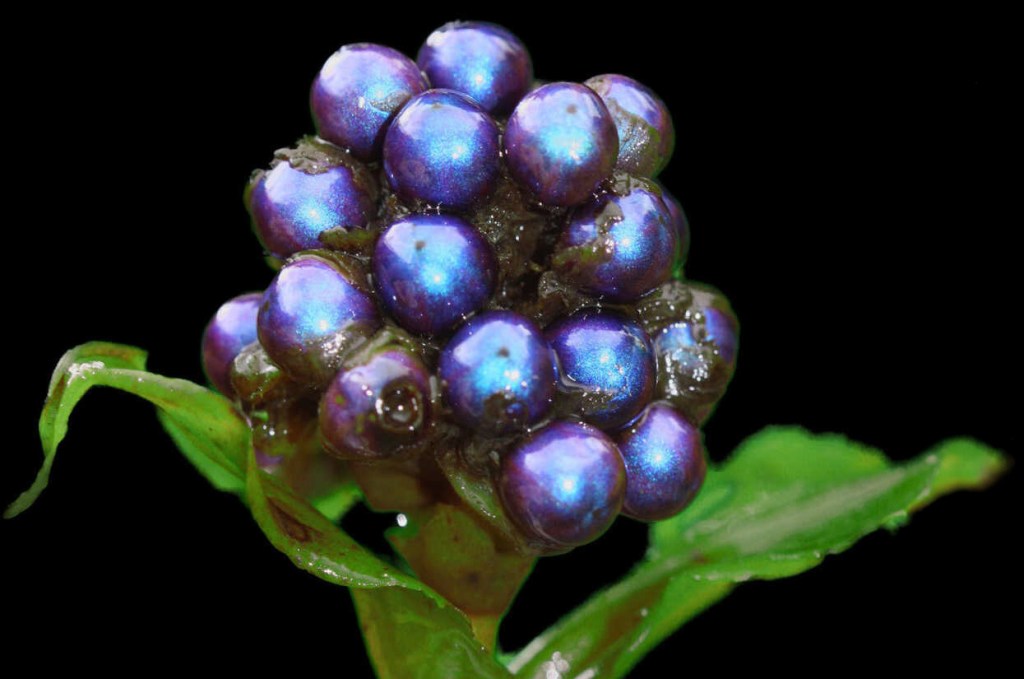
Professor Silvia Vignolini, Sparxell’s Chief Scientific Advisor, first encountered the fruits of Polia condensata (pictured) in the collection of the British Museum: more than a century after the fruits were first collected, their colours were as vibrant as the day they were picked.
It turns out that the colour vividness occurs because of the peculiar arrangement of the cellulose chains in the cell wall of the fruits, giving the fruit an intense structural colouration — one of the brightest colours of all biological materials.
Dr Benjamin Droguet, Sparxell’s Founder & CEO, as part Professor Vignolini’s group at the University of Cambridge, demonstrates the use of industrial machinery to replicate the same vibrant colours found in nature using plant-based cellulose.
Sparxell was then born to provide nature’s most exquisite and sustainable colours at commercial scale.
Plant-based
Biodegradable
Award-winning — breakthrough material science company.
Sparxell’s sustainable technology has received numerous awards and mentions.
Sparxell’s patented technology delivers the latest material science innovation.
1 Cellulose rich sources such as wood pulp provide the building blocks of Sparxell’s pigments and glitter. The core crystalline part of cellulose is extracted from these sources and dispersed into water randomly.
2 After prepping the cellulose crystals in water, they self assemble from a chaotic (isotropic) configuration into an ordered (cholesteric) state upon drying. Using our patented technology, the densely packed crystals now forms a film that reflects light and colour over a large area.
3 By controlling the interactions between the crystals, the cellulose film can be tailor-made to match a specific appearance. The film can then be ground and shaped into a range of sizes and forms —voilà! This is how we replicate nature’s most vibrant colours and effects.
A glimpse of our productS
Engineering the self-assembly properties of cellulose, we can mimic the same specific vibrant hues found in nature and achieve endless other variations of colours and effects. Our pigments are available in various sizes, from fine microscopic pigment powders to glitters, sequins and larger films.